Showing posts with label picture book. Show all posts

Tuesday, December 4, 2012

corduroy

Title: Corduroy
author:Don Freeman
 
about the author: 
Born in San Diego, California, Freeman moved to New York City in the 1940's to study art while making a living as a jazz trumpeter. He died in 1978, leaving his beloved audience with a treasury of classic children's stories. Corduroy is a story that all children can relate to.http://www.scholastic.com/teachers/book/corduroy 


grades: pre k- 1

summary:
The book tells the story of a teddy bear named Corduroy, displayed on a toy shelf in a department store. One day, a girl named Lisa arrives in the store with her mother and spots the bear. She is willing to buy him, however, her mother declines to spend more money and notes that a button is missing from his overalls.
After they leave, Corduroy decides to find the missing button by himself and embarks on a trip around the department store after it closes in the evening. He goes upstairs and finds furniture he had never seen before, including beds and mattresses. Thinking that one of the mattress buttons is the one he is missing, he pulls it hard and eventually falls down from the bed, making noise. The store guard arrives, finds the bear and puts him back in place.
The next day, Lisa comes back with the money she had found in her piggy bank and buys Corduroy. At home, she sews a button on his shoulder strap and the book ends with them saying that they had always wanted a friend and hugging each other.
 http://en.wikipedia.org/wiki/Corduroy_%28book%29 

my reaction: As a small child I absolutely adored this book. It is a book that will stand the test of time. My preschoolers really enjoy this book as well. They will sit and listen to the feel good story and brightly colored illustrations. 
 
lesson ideas:

Give each student two pieces of construction paper, and have them cut one of them into the shape of a large pocket. Show them how to apply glue to the edges (all but one) to attach the pocket to the other piece of paper. Encourage them to decorate their pockets after they dry. Then give them old magazines and help them to cut out pictures of objects that they like or that relate to them. Show them how to place the pictures into their pockets. Then have them take turns explaining which pictures they chose to put in their pockets and why.

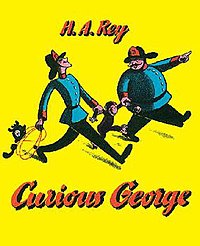
curious george

Title: Curious George
author: Margret Rey and H. A. Rey
about the author:
 Hans Augusto "H.A." Rey (born Hans Augusto Reyersbach; September 16, 1898 – August 26, 1977), worked with his wife Margret Rey as authors and illustrators of children's books. They were best known for their Curious George series.
 http://en.wikipedia.org/wiki/H._A._Rey


grades k-3

summary:  The man with the yellow hat captures a monkey called George in the jungle. They sail aboard a ship for a big city and George falls into the sea while imitating some birds. He is rescued and the ship finally puts into port. The man goes home with George but the monkey plays with the telephone and inadvertently calls the fire station, and is unfortunately taken to jail. Luckily, he escapes jail. Later, he tries to grab a balloon from a vendor, but takes the entire bunch and sails away high into the sky. The wind dies down and George descends, landing on a traffic signal. The man rescues him, buys all the balloons from the vendor, and takes George and the balloons to the zoo, George's new home.

My reaction: Curious George is a popular children's book with good reason. A child can relate to the mischief that George gets into. The illustrations are big and bright so that they alone can hold a childs attention and draw them back into the story. 

lesson plan: Have students create their own adventure for George to go on including an illustration to match. Have students share their stories and drawings with the class. 

The veveteen rabbit

Title: the velveteen rabbit
author:Margery Williams Bianco
grades: 3 and up

About the author:
Margery Williams Bianco (22 July 1881 - 4 September 1944) was an English-American author, primarily of popular children's books. A professional writer since the age of nineteen, she achieved lasting fame at forty-one with the 1922 publication of the classic that is her best-known work, The Velveteen Rabbit.

 http://en.wikipedia.org/wiki/Margery_Williams
 
summary: 
 A boy receives a Veveteen Rabbit for Christmas. The Velveteen Rabbit is snubbed by other more expensive or mechanical toys, the latter of which fancy themselves real. One day while talking with the Skin Horse, the Rabbit learns that a toy becomes real if its owner really and truly loves it. The Skin Horse makes the Velveteen Rabbit aware that "...once you are Real you can't become unreal again. It lasts for always."
When the boy's china dog is misplaced, the Velveteen Rabbit is given to the boy as a quick replacement by the Nana. The Velveteen Rabbit soon takes his place as the boy's constant companion. The Rabbit becomes shabbier, but the boy loves him no matter what. In the woods near the boy's home, the Velveteen Rabbit meets actual rabbits, and learns about the differences between himself and the real rabbits when the real rabbits prove he is not real by his inability to hop and jump.
The Velveteen Rabbit's companionship with the boy lasts until the boy falls ill with scarlet fever. The boy becomes too ill to play for a very long time; upon his recovery, he is sent to the seaside on doctor's orders. The doctor orders all the toys the boy has played with, including the Rabbit, be burned in order to disinfect the nursery. The boy is given a new plush rabbit and is so excited about the trip to the seaside that he forgets his old Velveteen Rabbit. While awaiting the bonfire, in which the Velveteen Rabbit will be burned, the Rabbit cries a real tear. This tear brings forth the Nursery Magic Fairy. She tells the Rabbit that he was only real to the boy, and then brings him to the woods and kisses him, making him real to everybody. He soon discovers that he is a real rabbit at last and runs to join the other rabbits in the wild.
The following spring, the boy sees the Rabbit hopping in the wild and thinks he looks like his old Velveteen Rabbit, but he never knows that it actually was.
 http://en.wikipedia.org/wiki/The_Velveteen_Rabbit

My reaction: A wonderful tale of being appreciative of what you have and that the greatest things are not necessarily the most expensive. The stories message rings clear even years later.

lesson ideas: Have students write about their favorite toy and why it is their favorite.

where the wild things are

Title: where the wild things are

author: Maurice Sendak

about the author:Maurice Bernard Sendak is an American writer and illustrator of children's literature who is best known for his book Where the Wild Things Are, published in 1963.Sendak was born in Brooklyn, New York, to Polish-Jewish immigrant parents, and decided to become an illustrator after viewing Walt Disney's film Fantasia at the age of twelve. His illustrations were first published in 1947 in a textbook titled Atomics for the Millions by Dr. Maxwell Leigh Eidinoff. He spent much of the 1950s working as an artist for children's books, before beginning to write his own stories.
 http://www.goodreads.com/author/show/4489.Maurice_Sendak
 Maurice Sendak

grades: 1-4

summary:A young boy named Max, after dressing in his wolf costume, wreaks havoc through his household and is disciplined by being sent to his bedroom. As he feels agitation with his mother, Max's bedroom undergoes a mysterious transformation into a jungle environment, and he winds up sailing to an island inhabited by malicious beasts known as the "Wild Things." After successfully intimidating the creatures, Max is hailed as the king of the Wild Things and enjoys a playful romp with his subjects; however, he decides to return home, to the Wild Things' dismay. After arriving in his bedroom, Max discovers a hot supper waiting for him.

my reaction: This book was a childhood favorite of mine. I love the bright illustrations and the dream like world that Max creates. Children and adults can relate to creating their own fantasy world to avoid real life and child play.

lesson plans: Have students write about a dream world  they create. Be sure to include supporting details and rich language. Have students illustrate their dreams. compare and contrast the book with the movie.

Monday, December 3, 2012

The Very Hungry Caterpillar

Eric CarleThe Very Hungry CaterpillarTitle: The Very Hungry Caterpillar


 Author: Eric Carle

About the author:
Eric Carle (born June 25, 1929) is a children's book author and illustrator, most famous for his book The Very Hungry Caterpillar, which has been translated into over 30 languages. Since The Very Hungry Caterpillar was published in 1969, Eric Carle has illustrated more than seventy books, many best sellers, most of which he also wrote, and more than 71 million copies of his books have sold around the world.
 http://www.goodreads.com/author/show/3362.Eric_Carle

grades: pre-k- 5th
 
Summary:  This is the story of a caterpillar and his transformation of metamorphosis. He goes from eating all the food to being in a cocoon and then into a butterfly. 

My reaction: I think this is a great book to teach children about metamorphosis and a way to connect science and literacy. The illustrations are well done and capture childrens interest even at the pre school age.

lesson ideas: Have students create their own butterfly using paint. Have students paint their hands different colors and then place them on paper. Also children can create caterpillars by using different paints and placing them in a row. Cut small pieces of  yarn for the antenas. Both are ways to connect art and reading.

the mixed up chameleon

Title: The mixed- up chameleon
Author: Eric Carle
Eric CarleAbout the author:
 Eric Carle (born June 25, 1929) is a children's book author and illustrator, most famous for his book The Very Hungry Caterpillar, which has been translated into over 30 languages. Since The Very Hungry Caterpillar was published in 1969, Eric Carle has illustrated more than seventy books, many best sellers, most of which he also wrote, and more than 71 million copies of his books have sold around the world.
http://www.goodreads.com/author/show/3362.Eric_Carle 

grades: pre-k - 4

Summary: The chameleon's life was not very exciting until the day it discovered it could change not only its color but its shape and size, too. When it saw the wonderful animals in the zoo, it immediately wanted to be like them -- and ended up like"all" of them at once.

My reaction: A great way to teach children about the importance of being an individual.  The illustrations jump off the page and grabs the readers attention. It can connect a science lesson to literacy when discussing animals and body parts.

Lesson idea:
 After reading The Mixed Up Chameleon. Go around  in  a circle and each child will make their statement, “I'm as _____ as a ______.” Write each sentence on a 12 x 18 inch piece of manilla paper. The students will then draw pictures to go with their statements. In the end, you will have a great class book.

chicka chicka boom boom

Title: Chicka Chicka Boom Boom
author: Bill Martin Jr.
about the author: 
William Ivan Martin, Jr. (March 20, 1916 - August 11, 2004) was an educator, publishing executive, and author of more than 300 children's books including Chicka Chicka Boom Boom, Brown Bear, Brown Bear, What Do You See?, Baby Bear, Baby Bear, What Do You See?, Panda Bear, Panda Bear, What Do You See?, and Polar Bear, Polar Bear, What Do You Hear?.
 en.wikipedia.org/wiki/Bill_Martin,_Jr. 


grades: k-3
summary:
The lower-case letters climb up a coconut tree in alphabetical order, until the tree bends so much that the letters fall to the ground. Capital letters (the older relatives of the letters climbing the tree) come to help them. Again alphabetically, it describes each letter's injury.

my reaction:
I think the book is well written in a way so that children enjoy learning the alphabet and the relationship between lower and uppercase letters. 

lesson ideas:
Have students create their own coconut tree's using sponge paint and use paint to make their letters. Have students use a magnetic board and cut out letters to retell the story on their own in small groups.